Showing posts with label Performance. Show all posts

Monday, 2 October 2017

48h Theatre Project

0


This past weekend, 21 Middle School students participated in the 48h Theatre Project at ISB. Starting at 4pm on Friday evening and finishing 4pm Sunday, it was an event of team-building, creativity, gaining confidence and having fun. In that time, the cast devised, prepared and rehearsed an original performance from start to finish. The final piece, titled Everyday Encounters, was presented as a promenade performance in which the audience was free to explore various spaces, while actors performed a mashup of solo movement scores, duet scenes and character development pieces.


21 UNIQUE INSIGHTS INTO THE LIVES OF 
STRANGERS. WE HAVE BEEN EXPLORING WHAT 
IS HIDDEN UNDERNEATH THE ENCOUNTERS WE 
HAVE WITH EACH OTHER, EVERYDAY, ALL OVER
THE WORLD. 

FOLLOW A CHARACTER, EXPLORE THE DIFFERENT 
ROOMS, AND WATCH AS THE ENCOUNTERS CHANGE 
EACH TIME.


But the event was much more than just a performance. As one student put it during the Q&A which followed the show, quoting Abraham Lincoln, "We spent a lot of the time building trust and confidence in each other, and I think it was Abraham Lincoln who said if you have 4 hours to cut down a tree, spend the first 3 hours sharpening the sword." 

Most of Friday evening was spent doing team building tasks, such as Shrinking Islands, and an exercise from Augusto Boal's Games for Actors and Non-Actors in which blindfolded participants are carefully moved around by their partner. The evening then culminated in watching West Side Story, before the special event of sleeping over at school together. 


After waking up and eating breakfast as an ensemble, a large part of Saturday morning was spent exploring expression through movement and gesture, using Anne Bogart's Viewpoints technique. Working in a full group exercise, we built images using elements of space, tempo, proximity, gesture, & voice. 

It's worth noting, that at this stage, students were still mostly in the dark about the content of the final performance but, without knowing it yet, were beginning to develop the necessary skills needed later in the day, and also to construct some of the early material which was then developed in the proceeding activities. 

The core devising task came after lunch on Saturday. As students took a break and played Werewolf, Sandie Pergallini and I gave a make-over to the two drama studios, the props/make-up room, and the dressing rooms; filling them with props, staging blocks, costumes, lighting and music, to create an actors playground in which a large-scale improvisation could take place. We also seeded the room with performance tasks, inspired by a workshop I took on site-specific, immersive performance with the (awesome) company Punchdrunk


For a list of example tasks, go to my post here.

It was sheer creative joy for over an hour, as the cast experimented with character, image, physicality and voice. Comedy duets formed, powerful and emotional stories were told, fragile lullabies were sung, and even a space filled with horrific screams and tales emerged. It was an exercise of risk-taking, of experimentation, and of students using a myriad of their skills and knowledge.

Much of the material created in this exercise became critical to our final performance, and for the rest of Saturday afternoon we began reflecting on, selecting, editing and developing the material, combining it with some of the work from early exercises until we more or less had the skeleton of a plan for the show.

That just left Sunday morning to smooth out the (many) wrinkles and to rehearse, before presenting our work to a full audience at 2pm.


The weekend was intense. Beautiful. Challenging. Full of student ownership and growth. A laugh a minute. Unforgettable. 

Thursday, 2 February 2017

Pina- Pushing a pin into it

0


The work of Pina Bausch and the Tanztheater Wuppertal has had a profound impact on my work as both an artist and a teacher. If you haven't seen anything of their work, then watching the 2011 film Pina is a jaw-dropping, heart-awakening place to start.


Among so many of her ideas and principles there is one that particularly stands out and continues to define my idea of performance- the idea of evocative images instead of illustrative.

Bausch wasn't your average choreographer, with a pre-planned vision of every piece she made. The work was driven by the dancers in the Wuppertal, by their thoughts, feelings, expressions.

There's a great section in Royd Climenhaga's book on Bausch where he references a time while she was working on the piece Walzer (1982). Bausch asked the company to explore the idea of a display in a natural history museum.

"In museums you can see where they collect animals, stuffed animals. You can see how they are preserved and how they stand there, the animals. or with insects, how they mount them so that people can look at them. An ensemble member questions, Do you want us to put it into words? and Bausch responds, No, I want you to do it, or do it to someone."
 (Was Tun Pina Bausch und Ihrer Tanzer in Wuppertal? 1983)

Climenhaga goes on to explain that Bausch wants to capture the pain of being mounted by a pin, or perhaps the discomfort of viewing such animals mounted in that way. She doesn't want her performers to recreate the image, it's too literal. You can imagine some novice students making the same mistake as some of her ensemble members back in '82 they tried to re-create the moment by pinning one of the others to the wall, and often we see students translate a prompt such as this into similarly literal expressions.

She wanted her ensemble to understand that  "It tells us about the feeling, but it doesn't give it to us. It's illustrative rather than evocative." She doesn't want to create an experience "where we may say "Ah, I get it, it's like animals in a natural history museum," because then you either get it or you don't, but in either case the image stops there, once the connection has been made."

(Climenhaga, Royd. 2009. 'Pina Bausch.' Routledge Performance Practitioners: 111-113)

This principle of "Don't show me the feeling. Give me the feeling!" is critical when devising work to have impact. It's turns one-dimensional scenes upon which the audience is but voyeur, into an opportunity for us to make our own connections and to experience the piece for ourselves.


If you don't know the work of Pina Bausch and would like to know more, then the film is a great introduction which you can follow up with Royd Climenhaga's detailed guide on her work. The book also includes many practical exercises to get your students creating in the same ways as the Wuppertal. Finally, although Pina sadly passed away in 2009, Tanztheater Wuppertal still performs many of her pieces all around the world, so if you can get to see it live, I would highly recommend it.

Wednesday, 24 August 2016

What I'm watching

0

Some of the upcoming shows in Brussels that I will be going to see:


The Common People
Jan Martens -Grip
September 15-16
desingel.be

The Common People' is a participatory project, installation and performance by choreographer Jan Martens and film director Lukas Dhont. Twenty-four duos - ordinary people - meet for the first on the scene . How they react to each other and the audience looking on? You witness how they are seeking (intimate?) Personal contact.


-I've always been interested in untrained dancers dancing and pedestrian movement as dance. It's something I have focused on in my own artistic practice and I'm proud to have participated in some projects similar to this in the past. So I'm very looking forwards to seeing The Common People and I've been interested in seeing some of Jan Martens work too.


Rain (live)
Anne Teresa De Keersmaeker/Roasa & Ictus
October 4-7
Kaaitheatre.be

Rain (2001) is one of Anne Teresa De Keersmaeker's most vibrant performances and is set to Steve Reichs Music for 18 Musicians. You are gripped by a kind of madness of movement. Like a spreading fire, it jumps from one body to another, without pausing at any one person. To the pulsing notes of Steve Reich’s minimalistic music – performed live by Ictus – ten dancers surrender themselves to an irrepressible collective energy. A bubbling network of breathing and speed connects them, as does that strange camaraderie that appears only beyond the limits of exhaustion.

-Seeing the work of Anne Teresa De Keesmaeker has been on my wishlist for a while. The choreographer's scores she creates, which you can find in various books of hers, are fascinating to me. Can't wait for this!


Meanwhile
Gaëtan Rusquet
November 9-10
Kaaitheatre.be

In this apocalyptic performance Rusquet has three performers build a construction. Is it a model or in fact an installation? The actors continually have to fight against the threatened destruction of what they are building up. By playing with the scale, the role of the body changes from pure power to helplessness. Its raw materiality, physical sound and inescapable language of movement make Meanwhile a penetrating performance. The passage of time and the relationship between humans and their environment become tangible: the history of a city unfolds before your eyes.

-One of the greatest performances I've ever seen involved the perpetual building and destruction of a wall, only that time the wall was made of old beer crates. That was from a theatre company Monster Truck from Essen, Germany, who I'm not sure are still making work. But if this is anything like that I'll be transfixed. No language in the show so I'm expecting it to be a piece of performance art that has power beyond words.

Friday, 10 June 2016

Performance is...

0

Performance is powerful.
Performance is engaged in current issues.
Performance is thought-provoking.
Performance is brave.
Performance is about us and our place in the world.


A few weeks ago, I wrote a post titled Theatre is not..., in which I discussed a poetry-slam project that some of my students were working on. Those poems have now been slammed and the results are awesome. Here are some of the poems that came out of it-


This is brave, passionate, thought-provoking Performance at its best.

Sunday, 13 March 2016

Theatre is not...

0

After reading the January 2016 edition (Provocative Theatre) of Scene, a monthly Journal from ISTA, I was reminded of my slightly more 'anarchic' days as a student and contemporary theatre maker, in particular by the words from Jess Thorpe in her contribution These bridges, these walls. Discussing the value of arts practice in the context of a prison, she reminds us that
"Theatre is not just about entertainment - although it is important to find enjoyment in it.
Theatre is not about showing-off - it takes a brave person to stand up in front of others.
Theatre is not a soft option - it requires a huge amount of hard work to create something authentic.
Theatre is not a treat - from the beginning of time humans have used creativity to respond to the world around them and to reflect their experiences. It is part of who we are."

When I reflect on the role of drama here at ISB, in a school community that is by most comparisons incredibly privileged, I am always asking myself 'What impact can art have on these students' lives?' and in turn 'How can these students have an impact through art on their community and the world in general?'

I feel very lucky as a teacher, to be given the freedom and respect to choose the content of my course and also have the flexibility to make plans based of the particular interests and requirements of each group. But I also feel a responsibility to these principles of theatre/art/performance/whatever, that the things we create to be shared with the world should have other values than just entertainment.

Myself, back when I was a high-schooler devising a piece called Charity with my local youth theatre; as a student learning about the Performance Art of Marina Abramovich, Ron Athey, Stelarc and others; studying Sarah Kane, Moisés Kaufman, Pina Bausch, Goat Island; and as a theatre-maker with our company Trace Theatre, I wore the mantra of 'changing the world through art' on my sleeve. I turned my back on all forms of theatre that were escapist, masturbatory, money-grabbing or any other derogatory definition I would give and became passionate only about performance that was socially and politically engaged.

A little older and little more experienced I have since broadened my terms of validity in the art world, but I still long to see and make work that has impact. Now, I have a responsibility to make work with my students that is engaging and catches the student's attention for longer than a single 40-minute block. At the same time, it is our duty as conscientious citizens of our community (/communities) to make art that is not just for entertainment
is not stagnant or stifled
is not pretentious or entitled
is empowering, determined, passionate, considerate
is aware of and designed for the wider communities than just the drama classroom


In one of my classes right now, we are working on writing and performing Slam Poetry. It's not traditionally something you might encounter in a Drama class (but is more likely to appear in a class entitled Performance Works) and at first students were hesitant to jump into the topic. Can't we do a script? Can't we play more games? Poetry, seriously? - were some of the initial reactions to the idea. Yet, after a class chatting openly about what the students are passionate about, what angers them, what they would change in the world, etc, they eventually all warmed up to the idea.

We began the project by writing down their thoughts ('the writing's on the wall' in this case). I felt that the students were not just paying lip-service for an assessment criteria or other such nonsense, with the contributions they made to the conversation. They were genuinely passionate about the topics they suggested, as well as being reasonably well-informed about the initial arguments they might have on such subjects.


The poems the students are creating are powerful, brave, passionate and thought-provoking. Our plan is to film the Slams and share them with as many people as we can, because we believe that their work is important and should be heard. 

For the rebellious, often idealistic, mind of a teenager the thought of changing the world is not inconceivable. It is only older, with more defeats under our belts, perhaps, that many of us become more weary, more cynical.

Reading this edition of Scene and working with my students has shaken me up again, filled my energy tank with some fuel and once over reminded me of the power of art and performance.

As educators, if we can help students find their voices they will show us that are not afraid to use them; for making noise, for disrupting the peace, for speaking out.

We should look more to the passion and energy of the young. We should remind ourselves that art is not disappearing, it is not insignificant and neither are we.

Sunday, 6 March 2016

21st Century Skills From Devising

0

Drama matters, now as much as ever, and devising is a particularly important and powerful part of the subject. In a recent post, my colleague Alan and I talked about why Drama = Life and here I want to expand on how devising supports this. If you're not sure what devising is, or want to her some of my take on it, then I have a blog post on it here: Devising: My Favourite Definitions.

This is also in response to the blog post 21st Century Skills In The Drama Classroom
written by Lindsay Price on the fantastic Theatrefolk blog.


The Four E's

Exploration

Pic: Frantic Assembly- Curious Incident Of The Dog In The Nighttime
(words by me)

Without the relative safety of a script guiding the rehearsal process, students find themselves exploring the realms of uncertainty. Devising provides us an opportunity to develop ideas without a predefined understanding of the final performance. We can discover surprising, new ideas and themes as we go, enjoying the ever-shifting nature of the process.

There is no script for life. Unexpected events happen all the time and having a positive, open-minded approach to the unknown is important to develop.

Egality

Pic: Forced Entertainment- The Last Adventures
(words by me)

With the strict roles of playwright/director/actor/crew and their associated hierarchies becoming challenged more and more in the performing arts, we find ourselves in a field were many people can be many things. Dancers make the costumes and have an influence over the content of their work. Performers have written their own scripts and created the video trailers to promote their shows.   

The best devising promotes collaboration in a more egalitarian hierarchies. By using the right strategies and methodologies , everyone involved can have an influence on the process, production and performance of their work. 


Expression

Pic: Tanztheater Wuppertal - Vollmond
(words by me)

Performance has always been about self-expression but devising puts it at the heart of the creative process; importantly, for everyone not just the writer and director. Devising harnesses the makers personal stories, thoughts, skills and ideas and embeds them into the art. 

Experimentation

Pic: Cupola Bobber- The Field, The Mantel
(words by me)

Without a script acting as road-map, without a single vision from a director, and with a wealth of stories and ideas to rub together, experimentation is the engine through which sparks of inspiration are developed into final material. Innovators are supported by their other collaborators, who are in turn innovating themselves. Together they can dabble or dive into all manner of disciplines, styles and techniques during the course of any given process.


If Performance is the body of the theatrical art forms, then for me devising is its soul. It has been the method by which many great contemporary performance companies have made their work. Personally, it forms the core of both my artistic and teaching practices and continues to accompany me through my life.


Tuesday, 1 March 2016

Devising: my favourite definitions

0

Devising, as a concept, is a tricky thing to pin down. Companies that devise and academics often talk in loose terms about how devising works. Alison Oddey, in her book Devising Theatre introduced it saying that "devised theatre can start from anything. It is determined by a group of people who set up an initial framework or structure to explore and experiment with ideas, images, concepts, themes, or specific stimuli that might include music, text, objects, paintings, or movement. A devised theatrical performance originates with the group while making the performance, rather than starting from a play text that someone else has written to be interpreted."

For me, as an artist and a teacher, there are three companies that have majorly influenced my understanding of devising. Goat Island and Forced Ents both have excellent resources and books which I recommend as great reading if wanting to know more about devising.

Unfortunately Goat island stopped making work in 2007, and their resources might be tough to get your hands on, but their little Schoolbook 2 described their process wonderfully. Replace the words Goat Island with your own class or group and this methodology can be something to aim for.


Tim Etchells eloquently describes the process of Forced Entertainment, in his book Certain Fragments


This one's a bit different, in that it was a company I co-founded with four friends. We worked together for four years before heading off on our separate ways, but in this time we developed our own practice of devising; a methodology which still guides me today.


Tuesday, 15 December 2015

More Passion For Performance

0

It's that time of the year where my students apply to be part of the upcoming ISTA festival. As part of the application I ask them to write a brief explanation about why they love Performance and why they want to take part. The answers I receive affirm that this is such an important subject for students to be able to study.


I already posted one of these statements, last year, and again this year I have received some powerful words from some others:

Julia B: "Theatre is my way of life. it is the air that I breathe, the water I drink. The adrenaline of being on stage, the lights, crew, cast, there's nothing better. And it doesn't stop there. The way I walk, talk, socialize has been influenced by acting. My mind thinks of a million different ways to create ideas and possibilities. The ideas flow and inspire myself and others with their concepts and originality. After I discovered my love for the stage, i couldn't stop. It was like a bottle was popped open and the soda started pouring out. 

There's a moment on stage that every actor knows about. The room silences, all eyes looking at you. But we don't get swallowed by fear, we use the energy of the atmosphere to embrace the performance. Create a new persona, make the audience forget about their lives and all live in that scene together.

ISTA is about meeting people, making long lasting friendships, and using everyone's passion for theatre to create something magical."


Julia G: "I've loved performing since I can remember. I would get really excited during the holiday season beacuse me and my cousin would always come up with a little skit and perform in front of our whole family. ever since those tiny performances, my love for theatre only grew bigger. 

I have to admit, I love the spotlight, but theatre taught me so much more. It taught me how to work in a team, communicate with other and communicate with the audience. It also taught me how to be self-confident and made me more and more like the people that I look up to, that would walk into a room and grab everyone's attention."

Alice F: "I love the experience and feeling of exhilaration and excitement of working with others and performing."

Brenna F: "ISTA is an acting opportunity that I don't want to miss. Only now, I know that it's not just about the light and costumes and applause or even the friends. Now, when I am on stage, I am not Brenna anymore. I become both me and not me. Once timid, acting brought me out of my shell, into the limelight. Without acting, I would still be watching others from the outside. To me, acting isn't just a hobby- it's something you commit to, and once you're committed, you can't go back."


Monday, 15 June 2015

Alice vs Wonderland: wonderful video production

1


We're very lucky at ISB to have a talented video production expert- Lisa O'Leary (Lisa on twitter). She does some fantastic work with the students and also for our productions.

I wanted to show off the work she did on Alice vs Wonderland this year, so please take a look at these two videos to see some of her and her student's work. Top notch!

This first one is a compilation of student work, but at time-stamp 12:15 you can see the full Alice vs Wonderland finale compilation.

The second video is of this years MS Spring Production of Alice vs Wonderland, with video and projections from Lisa and our assistant technician Francesco Di Paulo. Filmed by Lisa too!


More of Lisa's video, all of the ISB Performing Arts Department, here.

Wednesday, 1 October 2014

An AudioVisual Banquet. Part 2- This time with lasers!

1

The second set of groups working to integrate multimedia live-performance software (Isadora) with experimental spoken word performance at ISB. This time with lasers, smoke and more varied video effects!


Thanks again to Ed Grody, Lisa O'Leary and Francesco Di Paolo (the Theatre Lighting, Sound and Video teachers) for their support, ideas and time!


Wednesday, 24 September 2014

An AudioVisual Banquet. Intermediality- a collaboration,

0

This morning at ISB, Ed Grody, Lisa O'Leary and Francesco Di Paolo (the Theatre Lighting, Sound and Video teachers) and I collaborated for a one-off class, in which we wanted to bring our two groups of students together for a mini-project. The aim was to integrate multimedia live performance software (Isadora) with experimental spoken word performance and to play around with this as a sandbox.


Prior to this class, The Advanced Performance Works students worked collaboratively to create original texts, but without knowing what the end result would be used for. Below is the writing exercise which is good for collaboratively generating texts.

Meanwhile the Theatre Lighting, Sound and Video class were getting to grips with the Isadora software and with the live camera work. Then this morning we all got together and in just 40 minutes this happened...
Group 1

Group 2

Group 3


Collaboratively Generating Text Exercise

First I asked them to fold a piece of paper into 8 squares and to write a word in each square- the first words that came into their heads. Any nouns, verbs or adjectives. Then students ripped the squares apart so they had 8 separate pieces of paper. Then they paired up and shared the words they had written. Next it was the object of the pair to arrange the 16 words into a list that had some structure or meaning from them, could be into some kind of loose narrative, could be arranged by similar words, whatever. They were allowed to edit out up to 3 words that weren't fitting in at this stage. Then it was about writing a text together to include these key words into a larger piece of writing.


Friday, 19 September 2014

Performing with Voice- a collaboration.

1

Last year, me and a colleague of mine, Cat Leclerc, who teaches The Voice Works class here (https://twitter.com/MS_VoiceWorks), had one of our exciting discussions, which always tend to lead to us working on some new idea together. This particular conversation was about trying to find a way for our classes to collaborate. In the end we agreed to work independently for a couple of weeks, with our own students then to bring that stuff together for a final presentation, exploring the themes of dream, war, a race and crowds. With my Performance students, we explored the themes through silent movement pieces, students devising each part in small groups. With the Voice students, Cat looked at creating vocal soundscapes, with song, sounds and words.

After two weeks of workshops and creating some material, we brought the classes together to watch what each had made and then we mixed up the students into groups to work together on combining it into one piece.

This video is the result of two of the themes: war and crowds (which became protest). 


Thanks to Lisa O'Leary for the filming and editing.


The exciting part of this project was that students had to leave their comfort zones in order to bring the whole project together. Performance students at this age are much more comfortable with words, speaking tends to be easier than moving or expressing yourself through the body, and Voice students who are more confident with singing, need an opportunity to explore a much wider range of vocal sounds.
Bringing the students together in this way also helped elevate the performances from the regularity and safety of our individual classrooms. Adding some ceremony to the event lifted it to a new level and brought something special out of the students. And as a result, a rich and quite different final presentation was delivered.

Collaboration. It's great.


Friday, 12 September 2014

The Power Of One Word (Part 2)

0

The other half of my Advanced Performance Works class are also going through 'The Power of' process at the moment and creating some equally interesting performances, in very short amounts of time.

Here's one in response to this photo:

 The word this group chose to use was "Goodbye":


The next group took this photo of some ants, rotated it 180 degrees and interpreted it as their chosen word "Attention".


Finally, the last group chose this photo:
 And bent the rules (you can always bend the rules for a good idea in my classes) to include the words "I'm sorry."


Monday, 8 September 2014

The Power Of One Word

0

First thing Monday morning. Kids drag their feet into class. The lesson drags by as kids half sleep, half interact. By the time they've left they're just waking up, but too little too late. Right?

Wrong.

This morning The Advanced Performance Works class arrived ready to work, full of enthusiasm and energy and the lesson exploded into the week.

In our last session together we had been working on performance without words, in a session titled The Power Of Nothing. At the end of the session I launched our next task, The Power Of One Word, with an interesting social experiment. It went something like this:

Students were asked to each select a picture from a set of stimulus photos and attach one word to said picture. These pictures I get from a fantastic resource which is The Big Picture. They then present this picture and the spoken word to the group then lay it down in front of them. Then the experiment bit, (something I had never tried before but worked pretty well) was that I asked students to stand next to the photo they though the group should take forwards into the next part of the exercise, which would be to devise a scene based upon the image. Students could stand next to their own if they wanted, or move to another that inspired them more. 

Once students had selected for the first time, (a spread of a group next to one image and then a couple of individuals who had stayed with their own) I then asked the students to re-evaluate their choice to try to come to a group agreement. After a few re-evaluations students started to gather into two groups and from that point on didn't look like agreeing further. My original plan had been that the students would work in one large group, but as they had divided equally and organically into two groups, I changed my plan and let them continue like this.

- 'Brainwash'

- 'Abandoned'


Now in this morning's class and with the chosen stimuli in hands, I set the students to task- to create a short performance inspired by their image, in which they were allowed to speak only one word. They therefore had to choose carefully a new word which would have the maximum impact. It also encouraged them to think about the other elements of performance, in the absence of text, such as eye contact, movement, silence, lighting, music,  and to think carefully about the timing of the speaking of the word, given that it could only be said once.

In just 20 minutes, students were able to create absolutely gripping performances inspired by their chosen image. The words absolutely were powerful especially in the context of otherwise wordless performances, and the rest of the material was rich and delivered with commitment and focus.
In response to the 'Brainwash' photo, students spoke the word "Why?"

In response to the 'Abandoned' photo, students spoke the word "Next."


Not bad for a Monday morning...

Friday, 29 August 2014

Five Truths

0


What are the differences between five of the most influential European theatre practitioners of the 20th century? How would these five directors work with the actress playing Ophelia in the famous mad scene in Shakespeare's Hamlet? What would they ask the actress to do and how would they ask the actress to behave?

A video installation looking at these questions, called Five Truths and commissioned by the V&A in partnership with the National Theatre was created by a group of contemporary theatre makers lead by director Katie Mitchell. The multi-screen installation brings together five interpretations of Ophelia's madness in Hamlet. Ten screens of varying sizes simultaneously play films of Ophelia interpreted dramatically through the lens of Constantin Stanislavski, Antonin Artaud, Bertolt Brecht, Jerzy Grotowski and Peter Brook.


Tickets, Tickets, Tickets!

1

For this post, and others in the future, I want to share some of the tickets I and our department have purchased for upcoming theatre and dance performances. You may be interested in hearing my take on what is interesting to see in Belgium (and further afield) in the coming months...

First a bit of background. I have so far found two pretty good venues in Belgium for cutting-edge performance:
The first is in Brussels and it's called Kaai theatre, it's located near the Yser metro stop. It has a range of performance showing, anything from dance, to fringe theatre, to live art, some of which is in English.
The second venue is De Singel which is in Antwerp. This is a much bigger venue than Kaai and hosts many bigger scale international companies, again in theatre, dance and music. It's a beautiful venue and the shows are amazing, but expect to pay anything up to 50 euros for a ticket.

And the shows:

- Showing at the Kaai from 23/10-25/10 is a new show by Forced Entertainment, (A UK company that have been making experimental theatre for 30 years already, funny, unusual and thought-provoking often with a discussion of theatrical principles running through their work as well as some social/political content). Their piece The Notebook will probably be pretty sparse in 'showiness' and flair, just like the picture below, but will be an interesting delivery of some powerful messages from the book by Agota Kristof.
"The latest production by Forced Entertainment is based on the highly acclaimed novel The Notebook by the Hungarian writer Ágota Kristóf. The book tells the story of twin brothers evacuated to the Hungarian countryside during World War II, to stay at their impoverished grandmother’s farm. The unnamed narrators are social outsiders, surviving in and understanding the world by a harsh private code. Though strange and dysfunctional, the brothers are slowly revealed to be struggling moralists as Central Europe crumbles into vice, cruelty and opportunism. Kristof’s narrational language – bold, crisp and reduced – provides the basis for a compelling performance. The two performers stand side by side. Trapped in one voice and one shared perspective they tell their fascinating story, an unravelling knot of naïve logic, weaving dark and subversive humour from wartime hardships."
Tickets here


Next

- Showing at De Singel from 04/12 - 07/12 is a piece of dance from the Tanztheater Wuppertal, the company of the late great dance director Pina Bausch. If you haven't already seen the film by Wim Wenders- Pina, then you should. It's breathtaking! This performance of Auf dem Gebirge hat man ein Geschrei gehört at De Singel in my opinion is unmissable, even if you're not normally interested in dance. It's so accessible for all audiences and has some beautiful imagery and will be expertly executed.
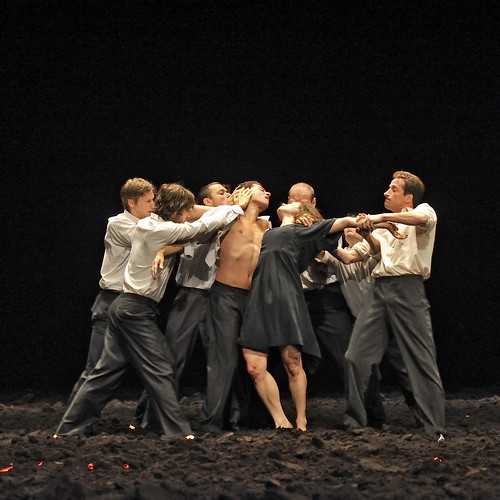
"The title of this 1984 piece is half a line from the story of the infanticide ordered by King Herod, as described in the Gospel of Matthew. We see a stage shrouded in mist and covered with a thick layer of earth. It is an arid terrain dominated by an initially vague atmosphere of menace and tension. The battlefield of deep human emotions then becomes more tangible. Crime and punishment, love and farewell create deep wounds. We are confronted with the battle of the sexes – completely in keeping with the situation in the eighties. What is disconcerting is that all pity is omitted. Pina Bausch shows us violence in a way she had never done before or since: brutal and extremely physical."
Tickets here


Following that

-Still at De Singel but from 25/01/15- 28/01/15 is a performance from the wonderful Robert Wilson, (He makes visual feasts on stage with a grand aesthetic and often unusual but entrancing performances from his performers). His show of Les Negres will be as visual striking as it is powerful in it's content. 
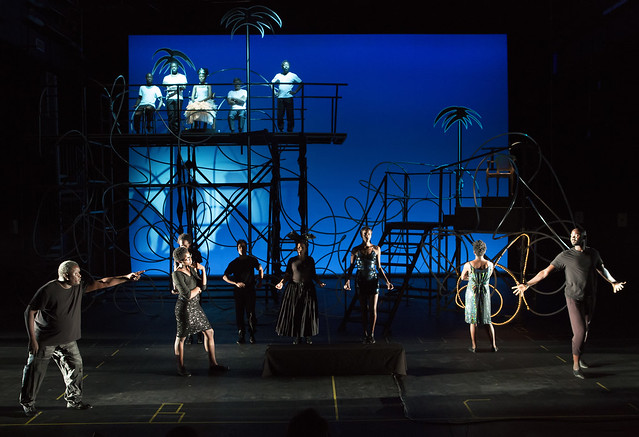
"When Jean Genet was commissioned to write a play for black actors in 1948, he knew little of the African continent. However, the French author did know all about humiliation. He had spent his childhood in care-homes and ended up in a juvenile detention centre at the age of ten. Throughout his life he remained an outcast. The inspiration for ‘Les Nègres’ was a music box, built in the eighteenth century, in which four black pages kneeled before a white porcelain princess, and Genet imagined how it would be if he changed around the skin colour of these figures. ‘Les Nègres’ became an almost clownish play in which all is artifice and pretext. Which is precisely what the director Robert Wilson wanted!"
Tickets here


Then

-I'm off to see two shows from an American company The Wooster Group, (of which ISB's very own theatre construction teacher Jim Clayburgh is a founding member). The Wooster Group is an experimental theatre company who's work consists of a combination of words, performance and technology. The company is also recognized for launching the careers of many actors, including Willem Defoe and Spalding Gray. 

Their first piece is showing at the Kaai from the 19/05/15- 23/05/15, called CRY, TROJANS! and it's based on Shakespeare's Troilus and Cressida
"CRY, TROJANS! originated as a coproduction with the Royal Shakespeare Company of Troilus and Cressida at the World Shakespeare Festival in conjunction with the London 2012 Olympics. In that collaboration, the two companies took opposite sides in the Trojan War: the Wooster Group staged the Trojan scenes while the RSC staged the Greek ones. Scenes with both Greeks and Trojans were staged by both, each side developing its own version. The companies worked separately and without consultation until they met a few weeks before performances to sew the two halves of the show together. The seam was intentionally left rough so that the contrast of artistic approaches remained a foreground feature of the production, accenting the face-off of warring cultures in the play."

Their second piece, showing the following week at De Singel from 28/05 - 31/05 is Early Shaker Spirituals.
"Early Shaker Spirituals’ is based on the music album of the same name by Sister R. Mildred Barker and her Shaker community in Sabbathday Lake (Maine). It consists of Shaker hymns recorded between 1963 and 1976. The Wooster Group sings the hymns as they sound on the album recording. The remaining fragments of the Shakers’ ecstatic dancing and physical gestures form the basis from which The Wooster Group develops simple dance patterns."